
Part of the Series: Technology, Innovation, Stewardship and the Future of Hawaiʻi Island
Jerry Nelson:
The Man Behind the Impossible Telescope
 By Carol Porter, Realtor® · October 31, 2026
When I mention to people I know that I am writing about Jerry Nelson, the ones with astronomy connections recognize the name immediately. Almost no one else does. And yet the twin domes of the W. M. Keck Observatory, high on Maunakea, changed what astronomers could see — and helped make Waimea an important home base for the people who build, operate, and support some of the world's most advanced telescopes.
That is why Nelson belongs in this series. He was not born here, and Hawaiʻi Island was not his home for his whole life. Santa Cruz, California, became his home base later on. But for a real chapter of his life — the chapter when the Keck telescopes were being built and brought to life — he lived here, and the work he led here is still shaping this island.
Jerry Earl Nelson (1944–2017) graduated from Caltech in 1965 and earned his PhD in physics from UC Berkeley in 1972. He worked at Lawrence Berkeley National Laboratory before joining the faculty at UC Berkeley as a professor of astronomy. In 1994, he moved to UC Santa Cruz, where he continued his work in astronomy and telescope design. Those are the tidy lines of a biography. The untidy, interesting part starts in 1977, when he proposed a telescope that many of his peers thought could not be built.
An idea everyone said would not work
At the time, there was a practical ceiling on the size of a conventional, single-piece telescope mirror. As mirrors grew larger, their weight made it increasingly difficult to maintain the precise shape needed for sharp images. Simply scaling up the familiar design was becoming technically and financially impractical. If astronomy wanted bigger eyes, it needed a different idea.
Nelson’s idea, conceived in 1977 at Lawrence Berkeley National Laboratory, was to stop trying to cast one enormous mirror at all. Instead, build the mirror from 36 thin hexagonal segments, fitted together and controlled so precisely that together they act as a single 10-meter mirror. The pieces were lighter. The shape could be maintained. The ceiling, in theory, was gone.
“In theory” is doing a lot of work in that sentence. Making it real took two enabling technologies that Nelson and his collaborators had to develop. The first was stressed-mirror polishing, a way to grind and polish each segment so it would take the right shape. The second was an active control system: 168 edge sensors measure the relative positions of the segments, while 108 actuators make minute adjustments to keep them aligned. The system repeats this process twice a second. Think of it less as a mirror that is finished, and more as a mirror whose shape is continually monitored and corrected.
Colleagues called it “the impossible telescope.” He was not refining the accepted design. He was asking people to trust a completely different one.
Building the twin telescopes on Maunakea
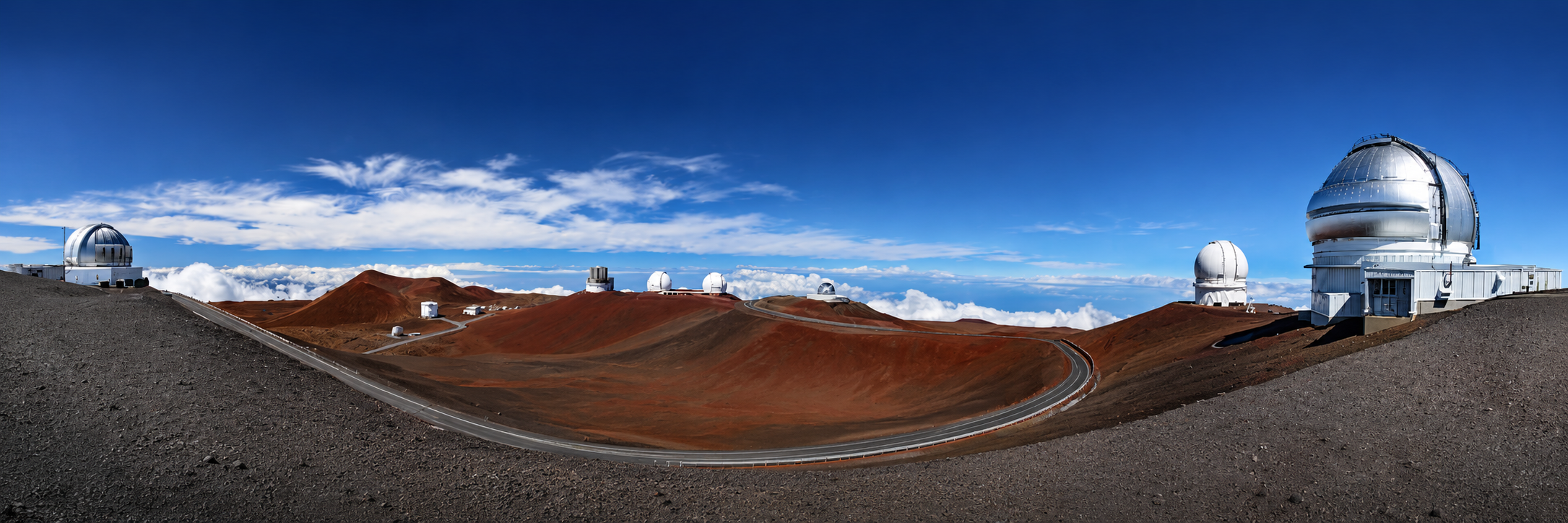
From 1985 to 2012, Nelson served as project scientist for the W. M. Keck Observatory. He led the building and commissioning of Keck I and Keck II, the twin 10-meter telescopes on Maunakea, and he later served as project scientist for the Thirty Meter Telescope. “Project scientist” can sound like an administrative title. In Nelson’s case, it meant holding the scientific vision and the engineering reality together, year after year, until the telescopes opened their eyes.
They opened them wide. Discoveries made with Keck include the supermassive black hole at the center of the Milky Way and observations that contributed to the evidence that the expansion of the universe is accelerating — the phenomenon associated with dark energy. Instruments built on Nelson’s design helped answer questions people had been asking for generations, and raised better ones.
His design established the blueprint for the generation of extremely large ground-based telescopes that followed, and its influence extended into space, including the James Webb Space Telescope. He was also a pioneer of adaptive optics — technology that helps telescopes correct for the blur of Earth's atmosphere — and the founding director of the Center for Adaptive Optics. Once you understand the segmented-mirror idea, you start to see Nelson's fingerprints almost everywhere modern astronomy looks at the skies.
A Big Island chapter, not just a work trip
When Keck construction started in 1990, Nelson moved with his family to Hawaiʻi and lived in Waimea (Kamuela) — the town where the W. M. Keck Observatory is headquartered — for five years, from 1990 to 1995, so he could stay close to the work. It was real residence, not a string of business trips. In a 2000 interview with the Honolulu Star-Bulletin, looking back, he described himself as “a one-time Hawaii resident.” He made the island home for a chapter of his life — the chapter when the telescopes were built — and subsequently continued his work at UC Santa Cruz, where he remained affiliated with the university until his death.
His family put down roots here, too. His two children attended Hawaiʻi Preparatory Academy (HPA) in Waimea, and his close collaborator and co-designer, Terry Mast, also moved to Hawaiʻi with his family for those years. Those Waimea years carried a personal cost: his first wife, Victoria, died in 1992. Nelson married again, in 1994, to Jocelyn Torricelli.
Keck Observatory’s remembrance of him gives us the man away from the dome. It calls him a “slipper-wearing, ocean-loving waterman,” remembers his vibrant Hawaiian shirts, and counts him as Keck ʻohana. He joined a local ocean-swimming group whose members ventured offshore with a small boat following. During his years here, Nelson frequently swam the stretch between Mauna Kea Beach and Hāpuna Beach. If you know that stretch of the Kohala Coast, you know that is not a casual dip. It is a serious, beautiful swim along a coastline I never take for granted. I am no open water swimmer, but the soft sand and very gradually deepening waters of Mauna Kea Beach and Hāpuna Beach are my favorite places on earth to swim in the ocean and dive through the incoming waves.
That challenging swim tells me as much about Nelson as any award list. The man who spent his days coaxing 36 pieces of glass to behave like one perfect mirror also made time, again and again, for the ocean. He did not just work on this island. He lived in it.
How he worked with people
Ask Keck colleagues about Nelson and, from everything I have read, you hear about character before you hear about genius. He was humble and ego-free. He treated everyone — a student, a technician, or a famous astrophysicist — with the same respect. He mentored generations of engineers, the kind of quiet influence that does not show up in a headline and shows up everywhere in a workplace, ten years later.
He was also famous for a mild little sentence: “I don’t understand.” Colleagues learned what it really meant. It did not mean he was lost. It meant your argument was about to be examined very carefully. I have sat across enough tables from thoughtful buyers and sellers to recognize that kind of listening. It is not soft. It is rigorous, and it is fair.
The honors came, and they were substantial. In 2010 he shared the Kavli Prize in Astrophysics with Roger Angel and Ray Wilson. In 2012 he received the Benjamin Franklin Medal. He was a member of the National Academy of Sciences. Nelson had a stroke in 2011 and kept working. He died on June 10, 2017, at home in Santa Cruz, at age 73, survived by his wife, Jocelyn; his children, Leif and Alexandra, from his first marriage to Victoria Wearne (who died in 1992); his sister, Jeanne; and three grandchildren.
Hawaiians and the pursuit of the heavens
The story of astronomy in Hawaiʻi did not begin with the modern observatories on Maunakea. The study of the heavens is deeply rooted in Hawaiian knowledge and history. The stars, their movements, and their relationship to the natural world were essential to traditional navigation and wayfinding. Hawaiian knowledge systems included careful observation of the sky, the ocean, the winds, and the natural world — knowledge that enabled extraordinary voyages across the Pacific.
Queen Liliʻuokalani made this connection explicit. In the introduction to her 1897 translation of the Kumulipo, she wrote:
“The ancient Hawaiians were astronomers, and the terms used appertained to the heavens, the stars, terrestrial science, and the gods.”
She was writing about a sophisticated body of knowledge preserved in Hawaiian tradition, not simply making a casual observation about the night sky. The Kumulipo itself is a genealogical creation chant that connects the origins of the natural world, humanity, and the Hawaiian people. Liliʻuokalani recognized the scientific and cosmological significance embedded in that knowledge.
King David Kalākaua was also an enthusiastic supporter of astronomy and modern scientific inquiry. His interest was not merely ceremonial. In 1874, he welcomed the British astronomical expedition that came to Hawaiʻi to observe the transit of Venus across the Sun. The observations made from Hawaiʻi were part of an international scientific effort to refine the measurement of the distance between Earth and the Sun.
In 1880, Kalākaua wrote to Captain R. S. Floyd, president of the Lick Observatory trustees, expressing his interest in establishing an observatory in Hawaiʻi. The following year, during his world tour, he visited the Lick Observatory in California and expressed enthusiasm for bringing a telescope to Hawaiʻi. A five-inch refracting telescope was subsequently purchased from England for Punahou School and installed in a dome above Pauahi Hall in 1884. It was the first permanent telescope in Hawaiʻi.
Kalākaua's words about the importance of scientific astronomy are especially revealing. He wrote:
“It will afford me unfeigned satisfaction if my kingdom can add its quota toward the successful accomplishment of the most important astronomical observation of the present century and assist, however humbly, the enlightened nations of the earth in these costly enterprises.”
These were not the words of a monarch indifferent to science or concerned only with preserving the past. Kalākaua wanted Hawaiʻi to participate in the intellectual and scientific endeavors of the wider world. He understood that knowledge, education, and technological advancement were important to the future of his kingdom.
There is something worth remembering in the traditions of the great Polynesian navigators: they looked to the heavens not as an abstraction, but as a source of knowledge essential to finding their way across the Pacific. That spirit of observation, curiosity, and discovery is very much alive in the pursuit of astronomy today.
The historical record makes one thing clear: the pursuit of knowledge about the heavens is not foreign to Hawaiian identity. It has been part of Hawaiian intellectual life for generations.
Native Hawaiian leaders supporting astronomy
That history continues in the work of contemporary Native Hawaiians who are carrying forward cultural knowledge through celestial navigation, natural observation, astronomy, and space science. Some are professional scientists; others are navigators, educators, community leaders, and advocates for opportunities that allow Hawaiian children to participate in scientific discovery.
Their support for astronomy is not abstract. Some have spoken directly in favor of the Thirty Meter Telescope (TMT), while others have devoted their careers to strengthening the connection between Hawaiian knowledge and modern science.
One of the most important voices on Hawaiʻi Island has been Richard Ha, a respected local kūpuna, farmer, businessman, and community leader. Ha became a prominent advocate for the Thirty Meter Telescope through his involvement with PUEO — Perpetuating Unique Educational Opportunities — a Native Hawaiian-led group formed to support educational opportunities for Hawaiʻi's children.
Ha and other PUEO members participated in the TMT contested-case proceedings, explaining why they believed the project mattered to the future of local students. Their concern was that children, including Native Hawaiian children, were expressing interest in astronomy but lacked the resources, encouragement, and educational pathways to pursue it. They saw TMT as an opportunity to help change that.
PUEO's position was not that Hawaiian culture should be set aside in favor of science. Its members argued that cultural identity and modern scientific education could coexist. Keahi Warfield, PUEO's president and an educator who worked with Hawaiian youth, spoke about the importance of providing opportunities while strengthening children's cultural identity and self-esteem.
Other PUEO members who testified included Richard Ha, Elroy Osorio, and William Brown.
Patrick Kahawaiolaʻa, president of the Keaukaha Community Association, and Wallace Ishibashi were also associated with the group.
Their message was fundamentally about the children of Hawaiʻi: a young person who is fascinated by the stars should have the opportunity to become an astronomer, an engineer, or a scientist without having to leave home simply because the opportunities do not exist here.
Another particularly compelling voice was Chad Kālepa Baybayan, master navigator and captain of Hōkūleʻa. Baybayan spent decades teaching the traditions of Polynesian wayfinding and the knowledge that enabled ancient navigators to cross the Pacific using the stars, the ocean, and other natural signs. He testified in support of TMT, describing the mountain as a beacon that connected him to the legacy of the people who sailed beyond the shoreline to discover new horizons. He saw participation in modern astronomy as culturally consistent with that history of exploration and discovery.
Milton “Shorty” Bertelmann was another important figure in the continuation of traditional Hawaiian wayfinding. A member of the original Hōkūleʻa crew on its historic 1976 voyage to Tahiti, he became a master navigator and was initiated into the Pwo tradition by Micronesian master navigator Mau Piailug in 2007. Along with his brother Clay, he helped establish Nā Kālai Waʻa Moku o Hawaiʻi, an organization dedicated to perpetuating traditional voyaging and navigation, and was instrumental in the building and sailing of the voyaging canoe Makaliʻi. His life’s work helped carry forward a sophisticated body of knowledge grounded in close observation of the stars, ocean, wind, and natural world.
Dr. Paul Coleman, the first Native Hawaiian to earn a doctorate in astrophysics, was another powerful advocate. A University of Hawaiʻi astronomer, he spoke about the connection between his own genealogy, the Kumulipo, and cosmology. For Coleman, studying the origins of the universe was also a way of investigating the origins of his ancestors. He believed that Hawaiians should have the opportunity not only to participate in astronomy but to lead in it.
Dr. Heather Kaluna, a Native Hawaiian astronomer from Puna, also testified in support of TMT. After graduating from Pāhoa High School, she pursued astronomy at the University of Hawaiʻi at Hilo and went on to earn her doctorate. Her research included the study of water on asteroids and the origins of Earth's water. She represents precisely the kind of scientific career path that local educational and research opportunities can make possible.
Amber Imai-Hong, an avionics engineer from Keaʻau and a Native Hawaiian, has also spoken publicly in support of TMT. Having worked at the Canada-France-Hawaiʻi Telescope and the East Asian Observatory, she understands the work and career possibilities that astronomy makes available. She has emphasized the need for STEM jobs on Hawaiʻi Island and the possibility of astronomy and Hawaiian culture coexisting.
Former Office of Hawaiian Affairs trustee Peter Apo was another prominent Native Hawaiian voice in support of TMT. He spoke about the importance of the Hawaiian legacy of seeking knowledge and argued that the pursuit of astronomy was consistent with Hawaiian identity. His comments challenged the impression that opposition to TMT represented the only Native Hawaiian perspective.
 Mailani Neal, a young Native Hawaiian astronomy advocate from Kona, brought the next generation into the discussion. She founded the We Support TMT petition and spoke about the importance of being able to pursue astronomy and scientific education while remaining connected to her Hawaiian identity and home.
These are not interchangeable voices. They come from different generations and different backgrounds: a farmer and community leader, a master navigator, an astrophysicist, a professional astronomer, an engineer, a former public official, and a young student. What connects them is their belief that Hawaiian identity and the pursuit of scientific knowledge are not mutually exclusive.
There are also many other Native Hawaiian scientists, educators, and cultural practitioners contributing to astronomy and space science. In 2023, testimony submitted to the Hawaiʻi State Senate described modern Native Hawaiians perpetuating cultural heritage through celestial navigation, natural observation, astronomy, and space science. Among those named were Brittany Kamai, Makana Silva, Tyler Trent, Kauionalani Brialyn Onodera, Kaila Nathaniel, Leinani Lozi, Kaʻiū Kimura, Larry Kimura, Naea Stevens, Kekoa Alip, and Kaimi Kahikihikolo.
Not every person in that broader group made a public endorsement of TMT specifically. Their work nevertheless demonstrates that Native Hawaiian participation in astronomy and space science is not limited to a handful of prominent advocates. It is an active and developing part of Hawaiʻi's scientific and educational community.
I believe these voices deserve to be heard. The public conversation about Maunakea has too often obscured the Native Hawaiians who support astronomy, work in the field, educate the next generation, and see scientific discovery as a continuation of their own intellectual and cultural traditions.
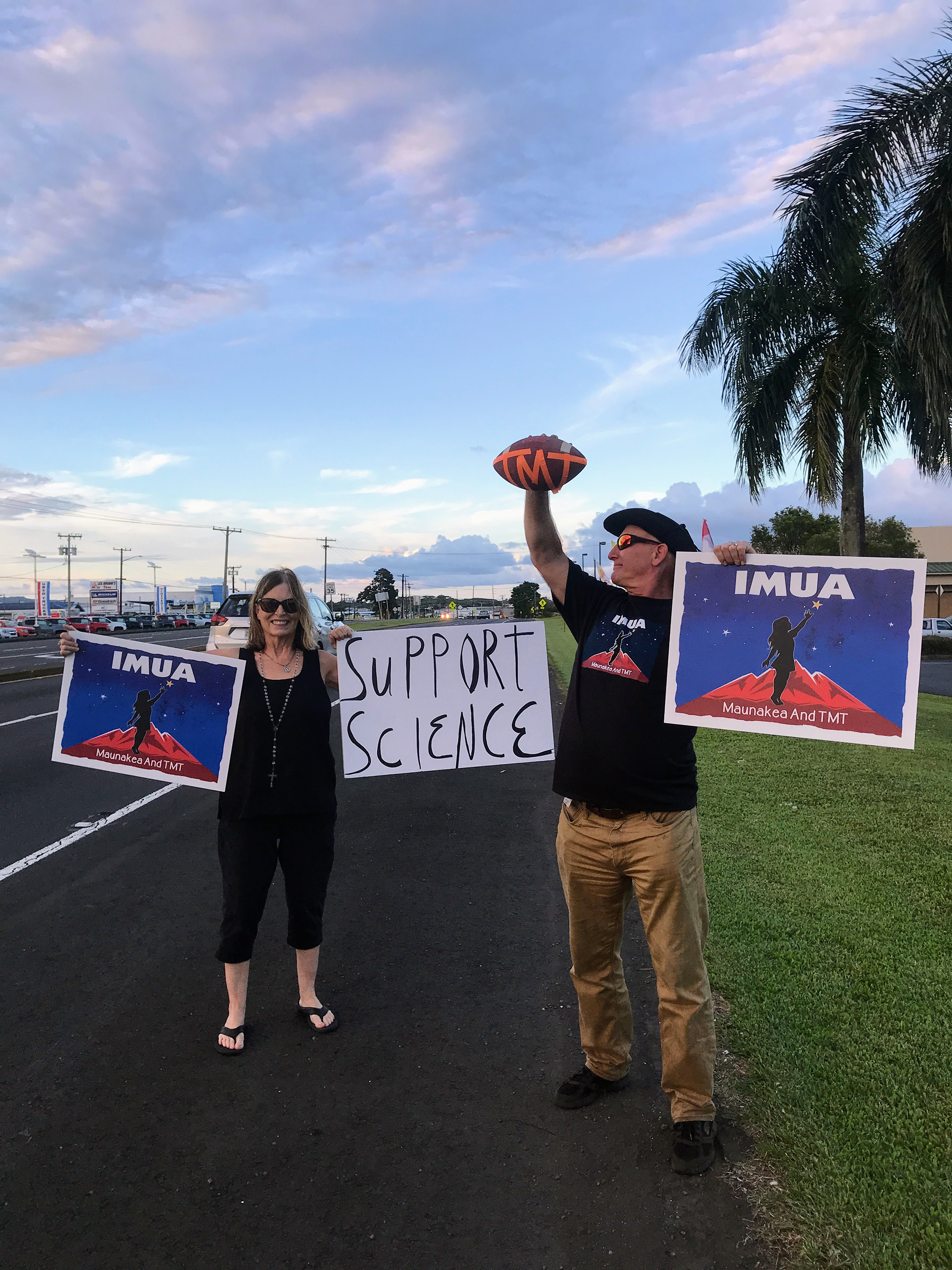
Astronomy and Hawaiʻi Island's future
The observatories on Maunakea are part of something much larger than the telescopes themselves. They connect Hawaiʻi Island to an international scientific community and bring together astronomers, engineers, technicians, educators, and other specialists whose work reaches across disciplines.
The existing observatories have helped establish Waimea as a place where people can pursue careers in some of the most advanced areas of science and technology. The broader astronomy enterprise also supports education, internships, research opportunities, and technical workforce development. Programs such as Akamai and HI-Star have helped introduce local students to science, engineering, and technology careers.
The proposed Thirty Meter Telescope represents another potential step in that development. Its supporters have emphasized the scientific discoveries it could make possible, but also the educational and employment opportunities it could bring to Hawaiʻi Island. The TMT project has made commitments to education funding, scholarships, classroom programs, and workforce development, including pathways into higher-paying technical careers.
For a relatively small island, that matters. Astronomy offers opportunities in scientific research, engineering, optics, instrumentation, computing, and other technical disciplines that might otherwise require young people to leave Hawaiʻi to find comparable work. It gives local students a chance to participate in an international scientific enterprise and perhaps build careers here at home.
Astronomy is also an industry with a very different physical footprint from many other forms of economic development. It is built around observation, research, engineering, and knowledge rather than large-scale resource extraction or conventional manufacturing. Although astronomy is not a polluting industry, observatories have significant environmental responsibilities. They must be carefully managed and held to high standards of stewardship.
The potential for a knowledge-based industry to provide meaningful employment and technical careers on Hawaiʻi Island is significant. I believe Hawaiʻi Island should continue to be a place where young people can pursue ambitious careers, contribute to important scientific work, and build their futures without having to leave home to do it. The legacy of Jerry Nelson, and the work of the Hawaiian leaders and scientists who support astronomy, are reasons I believe that possibility is worth protecting.
Waimea still feels his work
People sometimes call Nelson, in effect, the man whose telescope helped make Waimea an astronomy town. Keck Observatory’s headquarters are here in Waimea — Kamuela, on our post-office addresses — and over the years its engineers, staff, and visiting astronomers have become part of the town’s fabric. An observatory, it turns out, is not only a dome on a summit. It is also a community of people living ordinary, good lives in a small town lower on the mountain.
That is where my work touches his, lightly and honestly. I sell homes in Waimea and on the Kohala Coast — the same coast where Nelson swam between Mauna Kea Beach and Hāpuna. Some of the buyers I meet work at the observatories, or want to live in a town where that work happens. The astronomy community has become part of Waimea's working life, and its presence is one of the things that makes this community distinctive. At parties and gatherings around town, I have delightful and sometimes surprising opportunities to meet residents whose work in astronomy is not simply a profession, but a genuine passion.
Nelson’s telescopes were called impossible until they worked. Then, quietly, they helped establish a new way to build the world’s largest telescopes. I like to remember that the person behind them wore “slippahs” (flip-flops), loved the ocean, swam a hard and lovely stretch of our coast, and helped make possible a scientific enterprise that continues to bring knowledge, opportunity, and skilled work to Hawaiʻi Island. That is a legacy big enough for a summit — and human enough for a town.
Sources and further reading
Jerry Nelson and the Keck telescopes
- W. M. Keck Observatory, “In Memoriam: Jerry Nelson (1944–2017)” — https://keckobservatory.org/memoriam-jerry-nelson/
- University of California, Santa Cruz, obituary for Jerry Nelson (2017)
- Honolulu Star-Bulletin, interview with Jerry Nelson (2000)
- “The Impossible Telescope,” Keck Observatory documentary (17 minutes)
- National Academy of Sciences, Biographical Memoir of Jerry E. Nelson (1944–2017), by Judith G. Cohen
Hawaiian history and astronomy
- Queen Liliʻuokalani, introduction to her 1897 translation of the Kumulipo
- University of Hawaiʻi Institute for Astronomy, “Origins of Astronomy in Hawaiʻi”
- Hawaiʻi State Department of Land and Natural Resources, Thirty Meter Telescope Final Decision and Order, particularly the sections on Native Hawaiians and astronomy, PUEO, and educational opportunities
Native Hawaiian support for astronomy and TMT
- Richard Ha and PUEO testimony in the TMT contested-case proceedings
- Testimony of Chad Kālepa Baybayan, Paul Coleman, and Heather Kaluna in the TMT contested-case proceedings
- Hawaiʻi News Now, “2 prominent Native Hawaiians speak out in favor of TMT” (2017)
- Hawaiʻi News Now, “Amid mass protests, TMT supporter says telescope is being done ‘the right way’” (2019)
- Hawaiʻi State Senate testimony, April 3, 2023, identifying modern Native Hawaiians contributing to and supporting astronomy and space sciences
With aloha,
Carol Porter
REALTOR® · RS-87584 · HI · Better Homes and Gardens Real Estate Island Lifestyle
Next step
Questions about your own search?
Every situation is different, and the details change the answer. Tell me what you’re considering and I’ll give you an honest read.