
Hawaiʻi Design Matters · Furnishings
Walter Lamb:
The Art of Furnishing a Hawaiʻi Lānai
 By Carol Porter, Realtor® · November 16, 2026
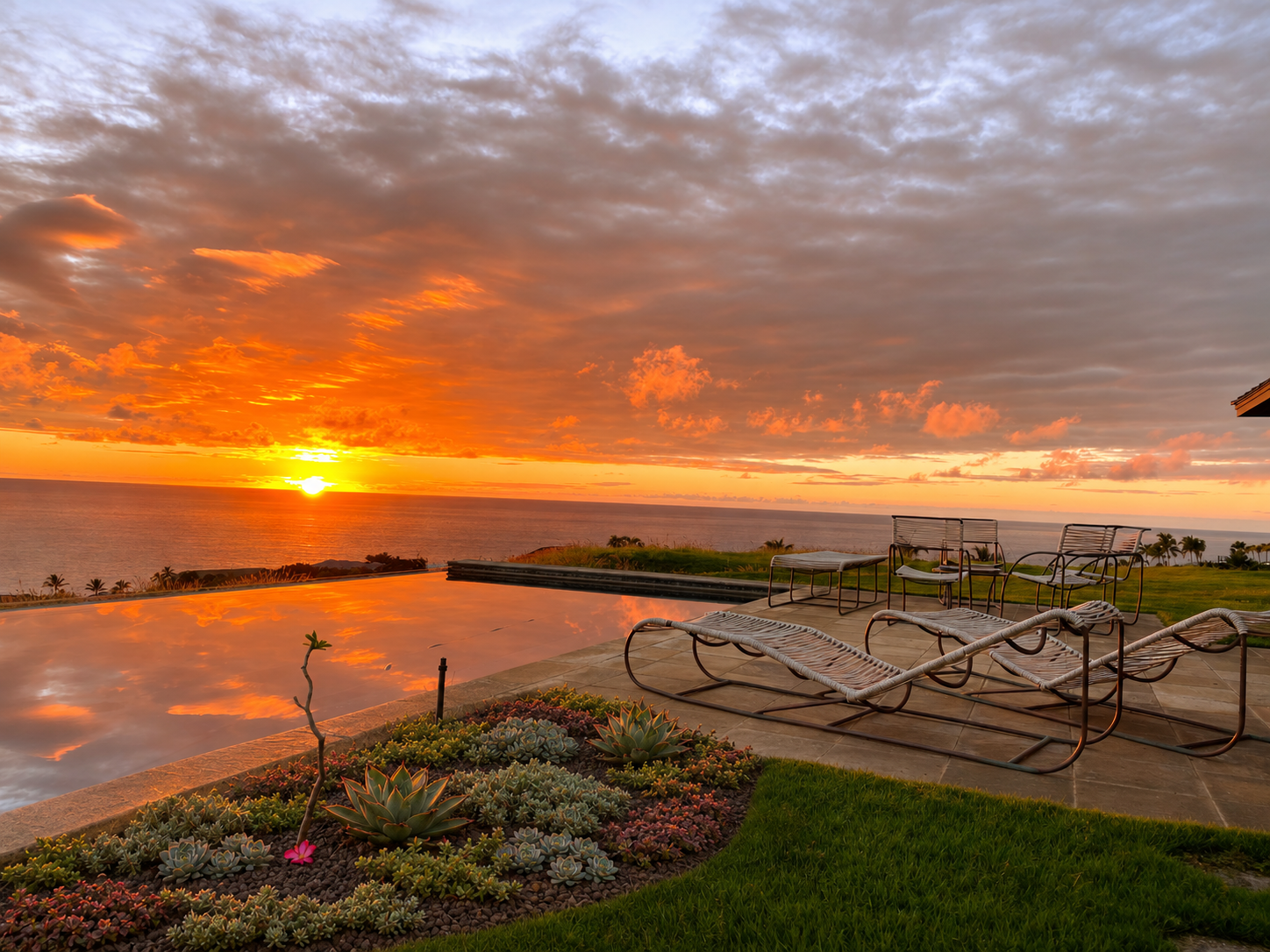
Start with the chair itself. Curved metal tubing draws the outline, and closely spaced cord makes the seat and the back. From across a room, a chair like this can look almost transparent, yet the cord gives where it needs to when you sit. Fill a lānai with this furniture — seating and tables, arranged as an outdoor living room — and you can still see the garden or the ocean through it.
Walter Lamb was a Berkeley-trained architect who moved to Hawaiʻi in 1935 and became best known for the outdoor furniture he designed in Honolulu. He began making furniture in wood. In the 1940s, he found a new material in bronze tubing salvaged after the attack on Pearl Harbor. Brown Jordan brought his designs into production, and the collection grew to include seating and tables for dining as well as lounging.
In Jane Marshall Goodsill's Voices of Hawaiʻi, Volume Three: More Untold Stories of the Aloha State, Lamb's daughter, Sandra Lamb Peterson, traces the beginnings of that work in “Walter Lamb Bronze Furniture” (pp. 71–73). Her account is the backbone of what follows, and where a detail rests on it, the text says so.
From a Honolulu woodshop to bronze tubing
Peterson recalls that her parents, Walter and Billie Lamb, moved to Hawaiʻi in 1935. Her father came with training behind him: a degree in architecture and interior design from the University of California, Berkeley, and fifteen years with a design company in San Francisco. Billie had a design career of her own in San Francisco, as a designer of gowns and wedding dresses. In Honolulu, Walter's first job was at Gump's on Kalākaua Avenue, heading interior design, and he built wooden lānai furniture in his mill on Kapiʻolani Boulevard.
Hana Hou! magazine tells the same arrival story: Lamb came in 1935 to head interior design for Gump's, and he was out of a job when war broke out six years later.
A few years after the attack on Pearl Harbor, while doing civilian design work for the U.S. Navy, Lamb took his daughter to the harbor to visit “Uncle” Babe Brown's submarine. Brown was a real officer — Captain John H. “Babe” Brown Jr., who by then commanded Submarine Squadron Four at Pearl Harbor. Battleship wreckage was being pulled out of the harbor, and the bronze tubing from the ships was piled on a nearby vacant lot. Peterson remembers the exchange plainly. Her father asked what would be done with it. “We don't know.” “Well,” he said, “I'll take it all.”
The tubing had served as conduit, securing the electrical wiring that ran throughout the ships. Lamb knew metalwork, and he saw how he could bend that conduit into free-flowing furniture frames. Other published versions of the moment differ in detail — in the Hana Hou! account, told through Honolulu restorer John Reyno, Lamb came across the pile while designing an officers' club for the Navy; an essay published by Wright and Los Angeles Modern Auctions describes miles of old bronze tubing in the salvage areas of Honolulu Harbor in the mid-1940s — and both accounts describe Lamb finding tubing in a salvage area.
The supply of salvaged conduit ran out as demand grew, Peterson says, and Lamb began importing bronze from the mainland. She remembers that the first frames used thicker, heavier tubing and that the next generation was lighter and slimmer. She also describes an acid wash that gave the bronze a verdigris finish — a green patina that would otherwise have taken much longer to develop outdoors. A green patina is part of the look collectors associate with Lamb, but it can't establish where the metal in a particular piece came from. Honolulu restorer John Reyno uses one-inch tubing as a clue that a piece may date to the original salvage.
Sources differ on Lamb's dates. Peterson and Hana Hou! give his death year as 1980, and the Los Angeles County Museum of Art lists his dates as 1901–1980. Wright and Los Angeles Modern Auctions give 1900–1989.
A chair drawn in curves and cord
Lamb used curved tubing to define the outline and closely spaced cord to make the seat and back. A chair can look almost transparent from across a room, yet the cord gives where it needs to when you sit. Peterson traces the line from the original chairs to chaises, sleigh chairs, rockers, Waikīkī chairs, settees, ottomans and tables.
The cord has its own history, and Peterson explains it in practical terms. The early pieces were wrapped with cotton clothesline rope, and the cotton worked fine in the Islands. Peterson recalls that the cotton darkened and deteriorated in mainland cities, prompting Lamb to switch to marine-grade polypropylene rope. The move to the mainland changed the name, too: “lānai furniture” became “patio furniture” when it started selling there.
The details vary among surviving examples. Los Angeles Modern Auctions documents a circa-1952 chaise with a bronze frame, cotton cord and a Brown Jordan label, while the Los Angeles County Museum of Art catalogued its circa-1954 chaise as brass and PVC. That chaise, a gift of Joel and Margaret Chen, was shown in the museum's exhibition California Design, 1930–1965: Living in a Modern Way.
Brown Jordan dates its partnership with Lamb to 1948. Peterson remembers a licensing agreement in the late 1950s that allowed Brown Jordan to manufacture and sell the designs under the Walter Lamb Bronze name. The company was still making pieces in 1984, as the labeled barstools catalogued by Heritage Auctions show. Brown Jordan reissued several designs in 2008. Its 2019 reissue used aluminum frames and polypropylene rope.
The design has a test to pass on my lānai on the Kohala Coast, and the test is wind. The chairs have stayed put through winds that uprooted trees on our property. A gust took the glass top from the dining table and sent it crashing down; the chairs stayed. What survives the wind here still has to do the other job — leave the view alone.
An Ossipoff lānai
Goodsill grew up in a house designed by Vladimir “Val” Ossipoff in the early 1950s — the Marshall and Ruth Goodsill House at 4258 Puu Panini Avenue in Honolulu, three pavilions around a courtyard and pool, published in Architectural Record in May 1955. When the house was finished, her parents asked Ossipoff how to furnish it, and he gave them a list. Get Robert Ansteth to design the living room and a large round dining room table. Paint the dining room wall Chinese red, and get Bernard Stuhlmacher of the Lantern Shop to find a screen for it. On the lānai, hang large round paper lanterns on either side of the couches he had designed. Then: add Walter Lamb Bronze chairs.
Her parents followed the list and did not alter the look for the next sixty years, changing only fabric as it wore out. A photograph in the book shows the result: two Lamb chairs in the foreground, an Ossipoff-designed pūneʻe — a movable couch, the daybed at the center of so many Hawaiʻi living rooms and lānais — the Ansteth round table, and an Angkor Wat charcoal rubbing on the wall. The whole arrangement reads as an outdoor living room. You can see through the chair backs to the furniture behind them, and the chairs hold their own beside the more substantial daybed.
Lamb had been Ossipoff's classmate in the architecture program at Berkeley, and the Liljestrand Foundation notes that his furniture was widely used by Ossipoff in many of his clients' homes. The National Register nomination for Ossipoff's 1937 Boettcher Estate in Kailua credits Lamb with the art deco lounge chairs on its lānai. In August 2024, Liljestrand House put more than twenty-five original Lamb pieces on its lawn for an exhibition and talk story with Goodsill, Reyno and Lamb's granddaughter, Hilary Sims.
Waipuna — the house the furniture came home to
The furniture came home, too. In 1943 Lamb designed and built a house for his family at 5975 Kalanianaʻole Highway in Honolulu. Preliminary plans were sketched by Vladimir Ossipoff, whom the Lambs had known since Berkeley. Wartime building restrictions and supply shortages shaped the work: the house went up in stages, the first stage about 1,000 square feet, not counting the outdoor lānai, and a 1946 expansion and remodel moved away from the original sketches. After the war, Peterson says, her father did design work for a renovation of the Royal Hawaiian Hotel and brought pieces of that renovation home — red Mexican tiles, hanging lights and cobblestone pavers, worked into the family house. The documented redecorator of the Royal Hawaiian's public rooms in 1946 was Frances Elkins, so Peterson's account places her father's work alongside that larger project rather than in place of it.
Billie named the family land Waipuna. It held a freshwater pool, Kānewai Spring, and a large round Walter Lamb Bronze table with six chairs stood by the spring for entertaining. Friends came after disembarking from the Lurline on Boat Day — the name Honolulu gave to the arrival of a Matson liner, with the Royal Hawaiian Band playing at the pier. Billie, who headed the Red Cross, threw the parties. In Peterson's telling, the guests included Esther Williams, Shirley Temple, the Disneys and the Roosevelts. Temple also owned Lamb furniture. Heritage Auctions sold an eight-piece group from her estate in 2016.
Today, the Maunalua Fishpond Heritage Center stewards Kānewai Spring. In 2017, the center acquired the property with help from the Trust for Public Land and public and private funding. A conservation easement protects the spring. Goodsill reached Peterson through the center's executive director, Chris Cramer. The property has passed out of the family, but the spring remains — and so does Peterson's account of the furniture that stood beside it.
What the market sees now — and how to live with old bronze
Peterson notes that vintage Lamb pieces can sell for thousands of dollars. In February 2023, a pair of chairs with a presale estimate of $1,000 to $2,000 brought $5,040 at Wright. Shirley Temple Black's eight-piece group sold for $9,375 at Heritage in 2016.
If you're looking at a vintage piece, check for a numbered Brown Jordan label and look closely at the tubing, finish and cord. Reyno considers the tubing diameter a clue to its age. The condition of the cord can tell you something about how the piece has been cared for, especially if you know when it was last rewrapped.
Brown Jordan recommends mild detergent and water for its current collection. On vintage frames, I'd leave the verdigris alone.
From a Mauna Kea villa to my lānai
I think of the photograph in Goodsill's book when I look at my own Walter Lamb chairs. Charles and Helen Schwab originally bought them for their villa at Mauna Kea Resort. The Villas at Mauna Kea were an early development at the resort — duplexes on the golf course above the hotel, within walking distance of the hotel and the beach. The Schwabs sold the villa furnished to a friend of Helen's, and I bought the Walter Lamb pieces from her.
The four armchairs came from a dining set. I still have the table frame in storage after a gust lifted the glass top and sent it crashing down. The chairs have stayed put through winds that uprooted trees on our property. I've had them rewrapped in UV-resistant marine-grade rope, and I wrote about living with the set in “Post-war Patio Furniture.”
From the house, I can still see the ocean through the backs of the chairs. The sunset through the cordwork is why it stays.
With aloha,
Carol Porter
REALTOR® · RS-87584 · HI · Better Homes and Gardens Real Estate Island Lifestyle
+1 808 769-0727
carol@betterislandlifestyle.com
Better Homes and Gardens Real Estate Island Lifestyle
68-1330 Mauna Lani Dr #308, Kamuela, HI 96743
Office hours 8:30 am – 5:30 pm · Available 8 am – 8 pm, seven days a week
Sources
Jane Marshall Goodsill, Voices of Hawaiʻi, Volume Three (Watermark Publishing, 2024), “Walter Lamb Bronze Furniture,” pp. 71–73 — Sandra Lamb Peterson's account. https://bookshawaii.net/collections/coming-soon/products/voices-of-hawai-i-vol-3
Hana Hou!, “Lounging Legacy” by Jack Truesdale, Dec 2024–Jan 2025. https://d8e7jbdw4fu0e.cloudfront.net/10665/5f460490-e7f6-11ef-87dd-8be0bc5db83d-vrgW1u7.full.pdf
Nicholas Brown, “Walter Lamb's Outdoor Furniture,” Wright / Los Angeles Modern Auctions. https://www.wright20.com/auctions/2023/02/american-design/270
Honolulu Civil Beat, Denby Fawcett, “These Chairs Started Out As Pearl Harbor Scrap Metal,” Sep 17, 2024 (John Reyno on one-inch tubing). https://www.civilbeat.org/2024/09/denby-fawcett-these-chairs-started-out-as-pearl-harbor-scrap-metal-some-now-sell-for-35000/
Los Angeles Modern Auctions, circa-1952 Walter Lamb chaise with Brown Jordan label. https://www.lamodern.com/auctions/2024/04/design/306
Los Angeles County Museum of Art, California Design, 1930–1965 checklist (Lamb chaise, c. 1954). https://www-images.lacma.org/s3fs-public/California%20Design%20checklist%20FINAL.pdf
Brown Jordan, Walter Lamb designer page and collection history. https://www.brownjordan.com/products/designer/walter-lamb
Heritage Auctions, Walter Lamb Bronze barstools manufactured by Brown Jordan, 1984. https://fineart.ha.com/itm/furniture/walter-lamb-bronze-a-set-of-six-bronze-and-rope-barstools-manufactured-by-brown-jordan-1984-paper-label-b/a/5014-73145.s?ic4=GalleryView-ShortDescription-071515
Azure Magazine, Walter Lamb Aluminum Outdoor Collection (2019 reissue). https://www.azuremagazine.com/spec-sheets/walter-lamb-aluminum-outdoor-collection/
Heritage Auctions, Personal Property of Shirley Temple Black, 2016. https://fineart.ha.com/itm/furniture/eight-piece-walter-lamb-group-of-bronze-verdigris-patio-furniture-circa-194036-h-x-48-1-2-w-x-33-1-2-d-inches-9/a/5283-63058.s
Maunalua Fishpond Heritage Center. https://www.maunaluafishpond.com/
Trust for Public Land, Kānewai Spring conservation purchase, 2017. https://www.tpl.org/our-work/kanewai-spring
Clean Water and Natural Lands, Kānewai Spring conservation easement. https://www.cwnl.org/conservation-sites/knewai-spring
USModernist, Vladimir Ossipoff houses (Goodsill House, 4258 Puu Panini Avenue). https://www.usmodernist.org/ossipoff.htm
National Register nomination, Boettcher Estate (Ossipoff, 1937), National Park Service. https://nara-media.s3.amazonaws.com/electronic-records/rg-079/NPS_HI/02000388.pdf
Liljestrand Foundation, “Walter Lamb Bronze — A Retrospective and Exhibit,” Aug 2024. https://www.liljestrandhouse.org/2024/08/01/special-event-exhibition-walter-lamb-bronze/
The Villas at Mauna Kea, Mauna Kea Residences. https://maunakearesidences.com/property/villas-at-mauna-kea-resort/
Carol Porter, “Post-war Patio Furniture,” Big Island Design, 2024. https://big-island-design.blogspot.com/2024/03/enduring-classic-post-war-patio.html
Note on sources: Details drawn from Sandra Lamb Peterson's account in Goodsill's book are attributed to her in the text. The account of the Schwab villa at Mauna Kea Resort and of Carol Porter's purchase of the furniture is the author's own. Where published sources disagree — including Lamb's birth and death years and the dates of the Brown Jordan relationship — the article says so rather than presenting one version as settled.
Next step
Questions about your own search?
Every situation is different, and the details change the answer. Tell me what you’re considering and I’ll give you an honest read.