
Design Matters: Hawaiian-style
Feng Shui in Hawaiʻi:
Wind, Water, the Design of Island Homes
An ancient Chinese approach to the relationship between people and their surroundings offers another perspective on Hawaiʻi’s architecture, landscapes, and indoor-outdoor living.
 By Carol Porter, Realtor® · November 7, 2026
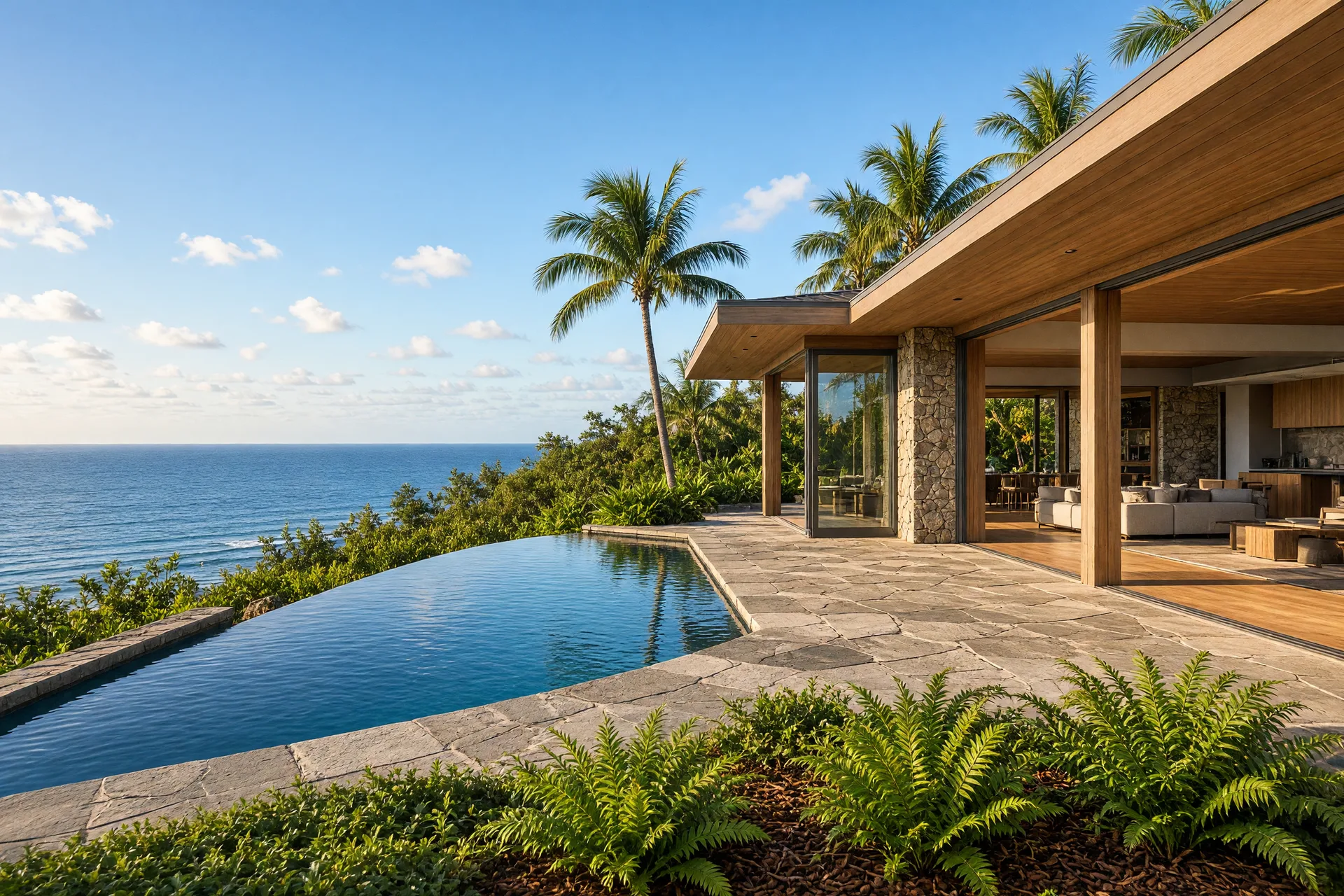
Years ago, I attended a feng shui class at Kūkiʻo, the private residential community on Hawaiʻi Island’s Kona Coast. Our instructor was Clear Englebert, a Hawaiʻi-based feng shui consultant and author of several books, including Feng Shui for Hawaiʻi.
He brought fabrics and other materials to demonstrate how relatively modest changes could address features of a home considered unfavorable under feng shui principles. I remember leaving the class thinking about two features of my own home: its glass entry door and infinity-edge swimming pool with the ocean beyond. Based on what I understood of the principles presented, I considered whether the apparent movement of water away from the house, and the openness of the entrance, might be favorable in my case. I reasoned that I am happy to share my good fortune; to cover all possibilities, I hung a few beautiful and helpful crystals.
Looking back, perhaps I should have paid closer attention. But the experience left me with an interesting question: How does a design philosophy developed in China apply to homes in Hawaiʻi, where ocean views, trade winds, expansive windows, and indoor-outdoor living are often fundamental to the architecture?
What Is Feng Shui?
Feng shui, literally “wind” and “water,” is a traditional Chinese practice concerned with the relationship between people, buildings, and their surroundings. Its historical applications include the selection and arrangement of sites in relation to landforms, water, direction, and other environmental characteristics. Different schools developed systems for interpreting the movement of qi, commonly translated as vital energy, and symbolic relationships among spaces, objects, and aspects of life.
Some approaches emphasize landforms and the physical environment; others employ compass directions and additional traditional systems. Practitioners do not necessarily agree on how a particular house should be evaluated or corrected. Clear Englebert describes his practice in symbolic terms: objects and spaces can carry meanings that influence how people interpret their environments. Such interpretations should not be confused with demonstrated physical energy flows.
A Chinese Tradition in Hawaiʻi’s Built Environment
Feng shui is not simply a contemporary decorating practice introduced into Hawaiʻi’s luxury residential market. Chinese immigrants and their descendants have contributed to the islands’ communities and built environment for generations. Architectural histories identify St. Peter’s Episcopal Church in Honolulu, associated with a Chinese congregation, as an example of feng shui considerations incorporated into a building with a Western architectural vocabulary.
Hawaiʻi’s architecture reflects many cultural traditions, including Native Hawaiian building practices, Asian influences, plantation-era construction, and later modernist design. Feng shui belongs in that larger history, but it should not be conflated with Indigenous Hawaiian knowledge; their cultural origins are distinct.
Mauka, Makai, and the Shape of the Land
In Hawaiʻi, we describe locations as mauka—toward the mountains—and makai—toward the ocean. These relationships matter in both practical architecture and some forms of feng shui. A home on a coastal slope may have elevated land behind it and an uninterrupted view below; another may be exposed to wind, afternoon sun, or heavy rainfall.
In a 2010 Honolulu Star-Advertiser account, Englebert described a favorable site through an armchair analogy: higher land behind the house and somewhat elevated terrain on either side provide a sense of backing and support. The account emphasizes landforms rather than a universal compass direction. On an ocean-facing lot, this framework may lead a practitioner to consider how the landscape seems to support or draw attention away from the house.
Englebert also suggested visually anchoring expansive ocean views with a substantial object, such as a statue or large ceramic pot. In his symbolic interpretation, this can keep energy from seeming to slide away. In ordinary design terms, a foreground object can provide scale and a visual point of reference. These are different explanations for a similar intervention.
A Tropical Climate Complicates Simple Rules
Hawaiʻi is north of the equator, but it is also within the tropics. For part of the summer, the midday sun passes to the north of the zenith; for much of the year, it is to the south. A blanket rule that north-facing or south-facing rooms are always preferable therefore misses important seasonal differences.
Trade winds, humidity, shade, rainfall, elevation, and roof overhangs also matter. A house on the dry Kona Coast has different environmental requirements from one in Hilo or the cooler Waimea uplands. The Chinese concepts of yin and yang offer a symbolic vocabulary for contrasting brightness and shade, exposure and shelter, or activity and quiet; those concepts are not substitutes for climate-responsive architectural analysis.
A 2012 study by Jung-Sup Um used spatial modeling to examine traditional burial-site distribution in South Korea. Solar exposure was an important predictor, and the author questioned the transferability of temperate-climate preferences to tropical conditions. The study concerned burial sites, not Hawaiʻi homes, so its results do not establish residential feng shui prescriptions. It does raise a useful question about the environmental origins of some traditional site-selection preferences.
Infinity Pools and the Appearance of Flow
An infinity-edge pool is designed to make water appear to extend toward the horizon. On a coastal hillside, the pool can seem to merge with the Pacific. In some feng shui interpretations, water apparently flowing away from a house symbolizes resources or prosperity leaving it.
The engineering is different from the appearance: water ordinarily spills into a catchment and recirculates. But symbolic interpretation concerns what a feature appears to communicate, not merely its plumbing. I have not verified a published statement in which Englebert specifically prescribes a remedy for infinity pools, and my memory of the Kūkiʻo class should not be represented as such a statement. I continue to appreciate the visual continuity between my pool and the ocean.
Glass Doors and Straight-Through Views
My recollection also involved my glass entry door. Englebert’s documented advice is more specific than a prohibition on glass. A 2019 profile discusses homes with a direct line from the front door through a rear door toward the ocean. In his interpretation, energy moves straight through rather than circulating within the house.
The profile describes two symbolic remedies: a clear faceted crystal suspended along the alignment, or a mirror at the rear door facing inward. These are reported as his feng shui recommendations, not as scientifically demonstrated methods for redirecting physical energy. The account does not establish that every glass entry door needs correction.
Architects may intentionally align an entry with an ocean view to create a dramatic arrival experience. A feng shui practitioner may evaluate that same arrangement differently. The distinction invites conversation about privacy, circulation, transparency, and what occupants value in their homes.
Gardens, Materials, and Modest Adjustments
Lanais, courtyards, paths, plantings, and water features extend daily life into Hawaiʻi’s landscape. Englebert’s Feng Shui for Hawaiʻi Gardens addresses these settings through symbolic associations and spatial relationships. Garden design also involves measurable concerns: drainage, soil, plant suitability, safety, maintenance, and weather exposure.
I remember Englebert demonstrating fabrics and other materials as possible adjustments. Screens, curtains, plants, furniture, mirrors, lighting, and decorative objects may be used as feng shui remedies. Some have plainly observable design effects: a screen creates privacy; a curtain filters glare; furniture redirects movement; a large pot anchors a view. Claims that these changes attract wealth or prevent misfortune belong to the tradition’s symbolic framework.
Feng Shui and Real Estate
A buyer who values feng shui may consider the shape of a lot, the placement of entrances, the relationship between doors and windows, or the position of water features. Another buyer may favor exactly the same features for architectural reasons. The appropriate professional response is to understand the buyer’s priorities, not declare either preference objectively correct.
Changes such as improving lighting, reducing clutter, or rearranging furnishings may help a property present well. But claims that feng shui adjustments reliably raise sale prices or shorten marketing time require evidence specific to the claim and market. Research about cultural housing preferences elsewhere cannot establish the result for an individual Hawaiʻi home.
What Does the Evidence Say?
A 2023 systematic review of empirical feng shui studies examined relationships among feng shui characteristics, environmental conditions, housing preferences, and human outcomes. The evidence had methodological limitations, especially for claims about well-being. It did not establish that feng shui causes health, happiness, or prosperity.
This distinction does not eliminate its value as a cultural tradition or as a way of thinking about the meaning of spaces. It helps us avoid confusing symbolic explanations with measured physical effects.
Feng shui also overlaps in subject matter with the investigation of so-called geopathic stress, which proposes that particular geological or earth-energy features may affect occupants. The traditions are different, and the claimed harmful fields of geopathic-stress systems have not been reliably demonstrated. For more on that subject, see the companion article, “The Ground Beneath the House: Geopathic Stress, Geology, and the Search for Healthy Places.”
Living With the Choices We Make
I still have a glass entry door and an infinity-edge pool, and I still appreciate the qualities that led me to choose them. But I remember Englebert’s class and the invitation to pay closer attention to our surroundings.
Whether we are considering the placement of a house, the direction of a view, the arrangement of furniture, or the objects we choose to live with, design involves more than appearance. It shapes how we move through spaces and experience the places we call home.
Carol Porter | Design Matters: Hawaiian-style
References
- Clear Englebert, Feng Shui website (fungshway.com)
- Clear Englebert, books (fungshway.com/books)
- Jung-Sup Um (2012), “Feng-Shui Theory and Practice Investigated by Spatial Regression Modeling”
- 2023 empirical feng shui systematic review
- Society of Architectural Historians, Hawaiʻi architectural history (SAH Archipedia)
Next step
Questions about your own search?
Every situation is different, and the details change the answer. Tell me what you’re considering and I’ll give you an honest read.